 Steinlog
05 — Ask
An answer you
can check.
Two questions come up on every bid. What does this tender actually require of us — and what does the law allow the buyer to do. Steinlog answers both in plain language, and both answers arrive with the source attached. X-Ray cites your documents. Ask the law cites the statute. Neither one answers without one.
X-RAY · ASK YOUR BID
Answers only from this tender's own documents. Cites the document, the page and the sentence.
ASK THE LAW · NL & EU PROCUREMENT
Answers only from an indexed corpus of procurement law. Cites the provision. Never legal advice.
X-Ray — ask your bid
Forty documents.
The answer is on page 14.
A tender arrives as a leidraad, a programme of requirements, annexes, a bill of quantities and a nota van inlichtingen — thousands of pages, and the line that decides your week is one sentence buried in the middle of one of them. X-Ray is a pinned panel in the bid cockpit. You ask; it reads the tender you actually received and comes back with the page.
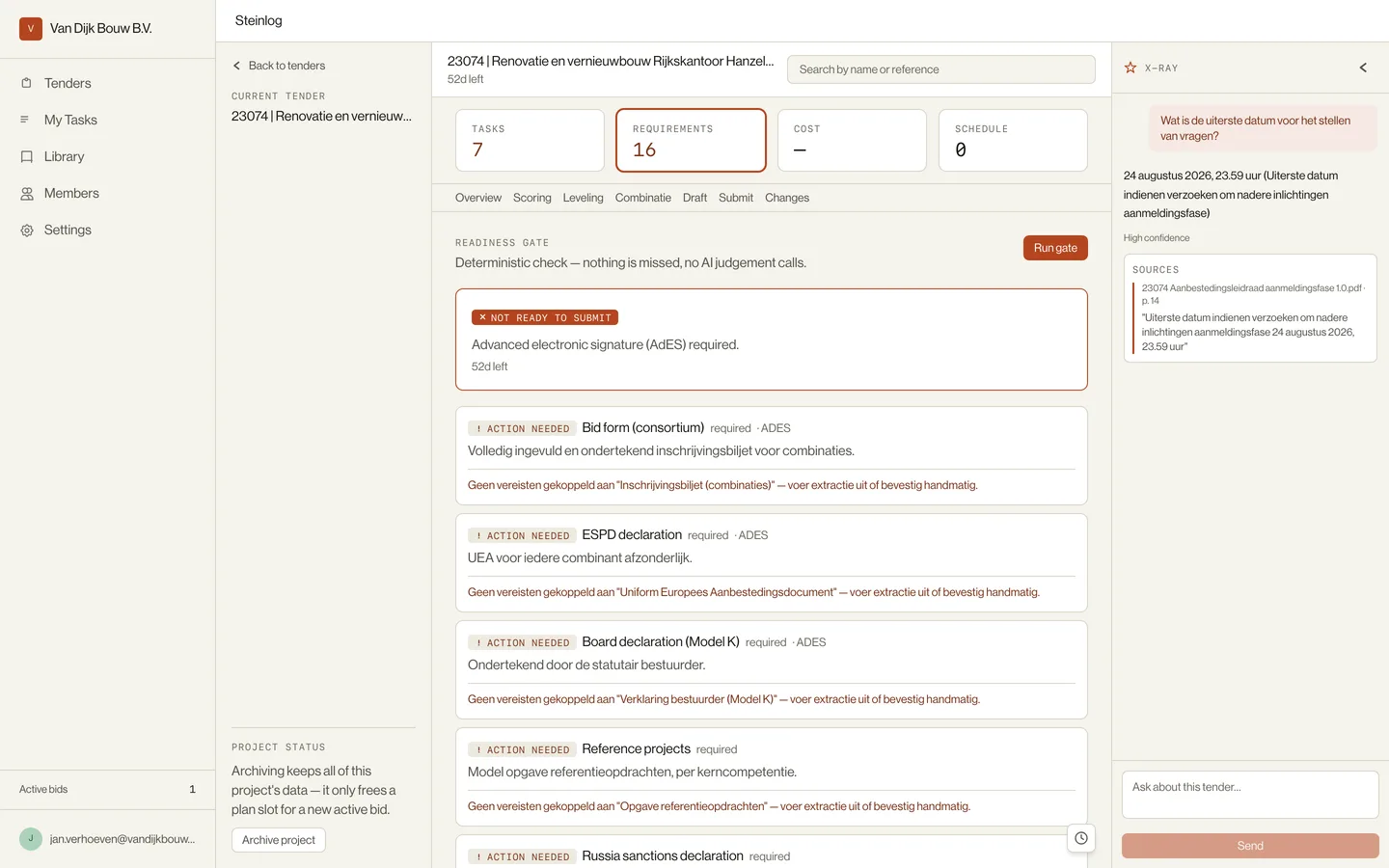
Recorded against the demo bid room on live TenderNed tender TN-431836, a real Rijksvastgoedbedrijf renovation. The question, the answer and the cited page are the real ones.
The citation is the answer.
An answer with no source is a rumour with good grammar. Every X-Ray answer carries three things: which document, which page, and the exact sentence it rests on. That turns checking from a re-read of forty documents into a two-second lookup — and it means the thing you paste into a planning email is traceable back to the tender it came from.
Answers come back in the language of the source. For a Dutch tender, that is Dutch — the quoted sentence is the buyer's own wording, not a translation of it.
- question
- Wat is de uiterste datum voor het stellen van vragen?
- answer
- 24 augustus 2026, 23.59 uur
- document
- 23074 Aanbestedingsleidraad aanmeldingsfase 1.0.pdf
- page
- 14
- confidence
- high
quoted from the page
“Uiterste datum indienen verzoeken om nadere inlichtingen aanmeldingsfase 24 augustus 2026, 23.59 uur”
Nothing here is illustrative. This is the answer the product returned, on a real tender, with the quote as it appears on page 14.
Where it sits
Beside the work,
not in another tab.
X-Ray is pinned to the cockpit, next to the readiness gate and the open requirements. The question you ask is almost always about the thing you are looking at — so the answer lands there, in the same view, and the page it cites is one click away.
On a consortium bid, retrieval is scoped to the person asking. A partner account gets the tender; it does not get your answer library. The wall is enforced in retrieval, not in the wording of the answer.
Free · no account
The Aanbestedingswet,
answered with the article.
Vraag de Wet answers questions about the Aanbestedingswet 2012 and EU procurement law exactly the way Ask does — with the provision attached, and a refusal when there is no source to stand on. It reads the public legal corpus instead of your tender, so you can try it before you have a bid room.
DOCUMENTS
31
PROVISIONS
1,587
INDEXED CHUNKS
2,027
The live index: the Aanbestedingswet 2012, the implementing decrees, the EU procurement directives and PIANOo guidance. Counted, not estimated.
One real answer.
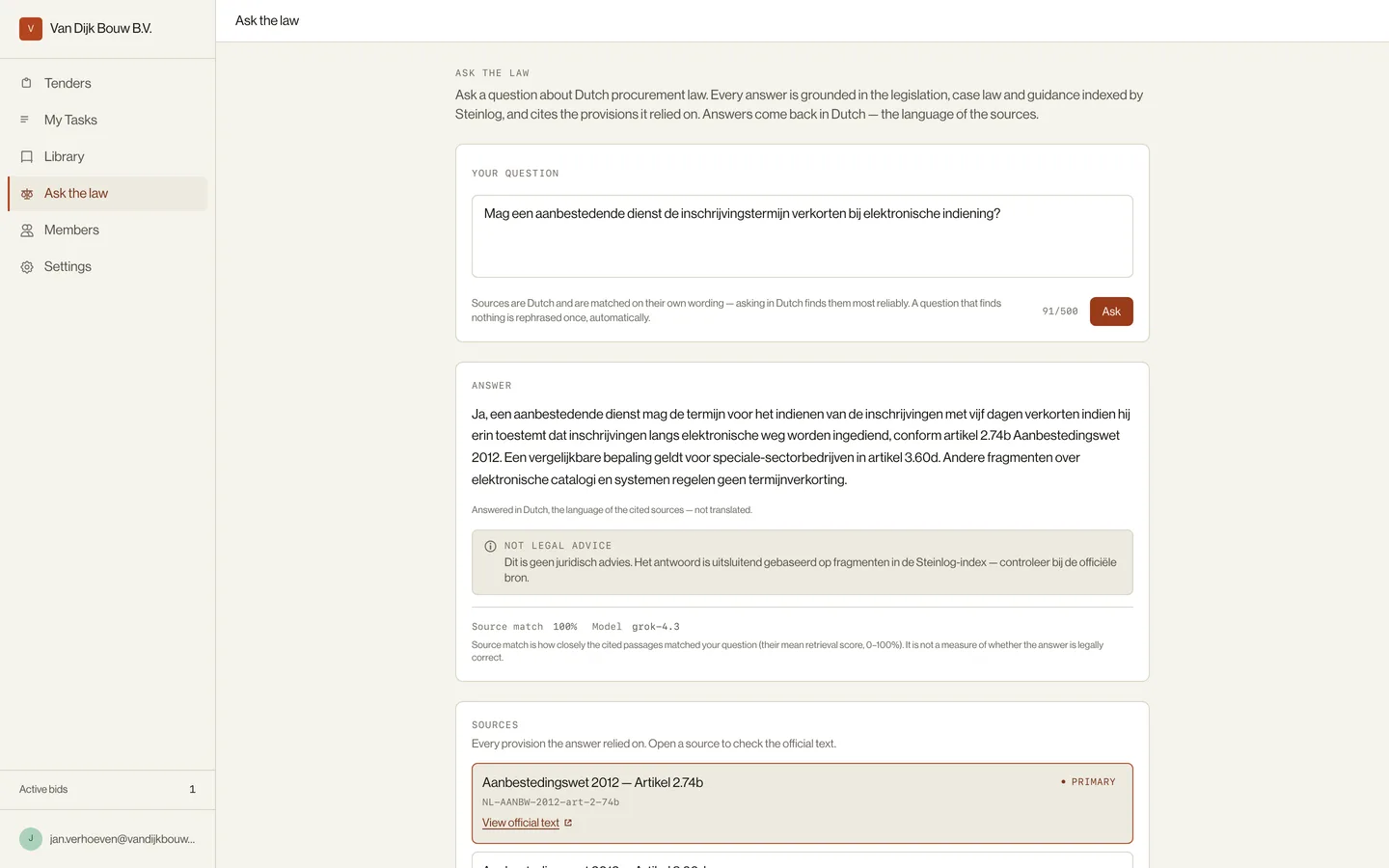
Asked whether a contracting authority may shorten the tender period where electronic submission is allowed, Steinlog answered: yes, by five days, where the buyer permits electronic submission — citing artikel 2.74b Aanbestedingswet 2012, naming the parallel article 3.60d for special-sector entities, and linking the official text on wetten.overheid.nl so the reader can go and read it.
The answer is in Dutch because the sources are in Dutch. That is deliberate: a translation of a statute is a paraphrase of a statute, and a paraphrase is not the thing you want to rely on. The interface is English; the law stays in its own words.
RENDERED VERBATIM ON EVERY ANSWER
“Dit antwoord is automatisch door AI gegenereerd op basis van fragmenten uit de Steinlog-index. Het is algemene informatie en geen juridisch advies; het kan onvolledig, onjuist of verouderd zijn en er kunnen geen rechten aan worden ontleend. Controleer altijd de officiële bron en raadpleeg voor een definitief oordeel over uw specifieke situatie een advocaat of aanbestedingsjurist.”
This answer was automatically generated by AI from fragments in the Steinlog index. It is general information, not legal advice; it may be incomplete, inaccurate, or outdated, and no rights can be derived from it. Always check the official source, and for a definitive judgment on your specific situation, consult a lawyer or procurement law specialist.
It is not a footer you have to hunt for. It ships with the answer, every time.
It is not legal advice,
and it says so.
Ask the law tells you what the corpus says and where to read it. It does not know your contract, your consortium, or the specific facts of your dispute, and it does not replace the person who does. Use it to get oriented before that conversation — and to have it with the article already open.
ON “SOURCE MATCH”
The page shows a source-match percentage. It is the mean retrieval score of the cited passages — how closely they matched your question. It is not a measure of legal correctness, and it is not a confidence score. A high match on the wrong question is still the wrong answer.
Why it cites
An answer you can check
beats an answer
you have to trust.
We are not going to tell you the model never gets anything wrong. Every model does. The useful question is what happens when it does — whether you find out in four seconds or four weeks, at the debrief, when the bid is already lost.
That is the whole design. Not a model you have to believe, but an answer that hands you what it read so you can disagree with it. On a bid worth millions, being able to check is worth more than being told.
It answers from the documents, not from the internet
X-Ray reads only the tender you were actually sent, and the versions you actually hold. Ask the law reads only the indexed corpus. Neither reaches for what a model happens to remember about procurement in general.
No source, no answer
If the retrieved evidence does not support an answer, it does not manufacture one. A refusal is a result — it tells you the tender is silent on the point, which is itself worth knowing before the question cutoff.
A bad citation fails loudly
If the model cites a passage that was not in the retrieved set, the request fails rather than returning the answer. A fabricated citation is the one failure that would defeat the point of citing at all, so it is treated as an error, not as output.
You can go and look
Document, page, sentence. Article and official text. Every claim on this page resolves to something you can open yourself.
Model: grok-4.3. Assistant inference is processed in Ireland (eu-west-1). Bid documents are stored in the EU, in one isolated database per client — see Security.
Free · no account
Want to see the citation discipline first?
Vraag de Wet answers questions about the Aanbestedingswet 2012 and EU procurement law exactly the way Ask does — with the provision attached, and a refusal when there is no source to stand on. It reads the public legal corpus instead of your tender, so you can try it before you have a bid room.
Open Vraag de WetAsk
Ask it something
you already know.
The fastest way to judge this is to point it at a tender you have already read, and check its answers against what you know. Bring one; we'll load it.
pilot@steinlog.com