
Understanding bid bonds in EU construction tenders
What a bid bond actually secures, the moments it can be forfeited, and the small administrative slips that quietly disqualify otherwise winning bids.
A bid bond is the contracting authority’s insurance that you mean it. When you submit an offer for a public works contract, the bond guarantees two things: that you will not withdraw your bid during its validity period, and that — if you win — you will sign the contract and provide the performance guarantee. It is small relative to the contract, but it is the first place a tender is lost on a technicality rather than on price.
What the bond actually secures
The bond does not protect you. It protects the buyer against the cost and delay of re-running a procurement because a bidder walked away. That framing explains every rule that follows: the authority wants certainty that the bond will pay out, instantly and unconditionally, if you fail to honour your bid.
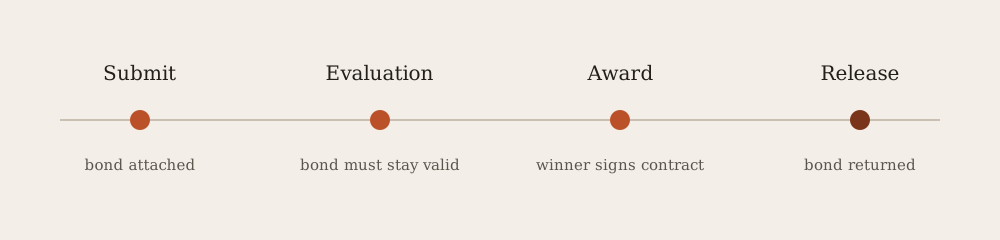
When it is forfeited
There are only a handful of trigger events, and they are remarkably consistent across jurisdictions:
- You withdraw or amend your bid after the submission deadline, within its validity.
- You win, and then refuse or fail to sign the contract.
- You win, and fail to lodge the performance guarantee on time.
- You are found to have submitted false declarations.
Note what is not on the list: losing on price. A compliant losing bidder gets the bond back. The risk is entirely about reliability, not competitiveness.
The slips that quietly disqualify
In practice, bonds are rarely forfeited — they are rejected at the gate. The recurring failure modes are administrative:
- Validity too short. The bond must remain valid for the entire bid-validity period, and authorities routinely extend that period. A bond that expires mid-evaluation is treated as no bond at all.
- Wrong amount or currency. Below the stated percentage, or denominated in the wrong currency, and the bond is non-conforming.
- Conditional wording. Anything that lets the issuer argue before paying out — a “subject to” clause, a demand-procedure carve-out — undermines the unconditional character the authority requires.
- Named beneficiary mismatch. The beneficiary must be the exact contracting entity named in the notice, not a parent ministry or a regional umbrella body.
Each of these is invisible until the gate check, and most are uncurable after the deadline. This is precisely the class of error a readiness gate should catch before you submit, not after.
A note on form
A bid bond is usually a bank or insurer guarantee, but the acceptable form varies. Some authorities accept a cash deposit or an electronic guarantee; others insist on a specific template. Read the notice for the permitted instruments before you commission the bond — arranging the wrong instrument costs days you may not have.
The discipline is dull and the stakes are high: a perfectly priced, technically excellent bid is worth nothing if the two-page guarantee stapled to it expires a week early.